British Shorthair of Silver Shaded, Point and Chinchilla Color:
The popularity rating of the British Shorthair cats is exceptionally high, and the number of owners is substantial. British Shorthairs are the classic of feline nobility! Representatives of this breed are incredibly tempting; their appearance is impressive and majestic. Their unobtrusive “control” over the family’s life, philanthropy, and the ability to display their beauty, combined with “participation” in family affairs, has led to a growing number of British Shorthair fans.
The Chinchilla/Silver Shaded British Shorthair color has been very popular overseas since it was first recognized in 1980 by both breeders and Cat lovers, thanks to its beauty, refined manners, and wonderful, kind nature. However, despite its many positive features, the Chinchilla/Silver Shaded British Shorthair is more rare to find in the US. Its popularity and uniqueness have become increasingly desired by both breeders and cat lovers in recent years.
Differences of a Silver Shaded, Chinchilla, Standard Point, and Color Point British Shorthair:
Within the silver gene lines, numerous names are used for these cats. I would like to take a little time to discuss some of the significant differences that many are not aware of, including some breeders. A very good friend and fellow breeder, Dr. Doug Schar, and I are collaborating on a project to create two pamphlets on this topic for the silver gene cat breeds. Once we gather more information, as there is very little available on silvers, we will make it accessible to all. One Pamphlet will be written in simple terms that everyone can understand, and another will be written for those who want to delve more in-depth into the why. However, in the meantime, I receive many requests from people who want a silver shaded chinchilla, which is actually a cat with two different colors. I thought this might help a bit for those searching for their new silver-colored British Shorthair Cat.
The number one difference, but one that is hard for most to see, is that chinchillas will only have about 1/8th or less of the upper hair shaft tipped in color. Silver Shaded will have at least 1/4th to 1/3 of the upper hair shaft tipped in color.
Another note is that Chinchilla and Shaded are actually a pattern, not a color.
Almost always, these little ones will have a gorgeous, darker makeup liner around their eyes, nose, and sometimes their mouth.
Ok, so now what does this mean 🙂
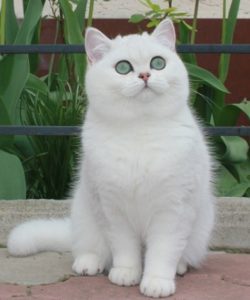 Silver Chinchilla will have a very light to no shading color, appearing more like a white cat. Typically has green eyes.


Silver Chinchilla Point … same as above, but will have some darker shading color typically, on some or all of their points ( Ears, Face, Tails, Legs), always with blue eyes.

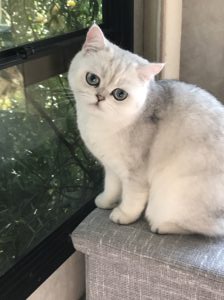
Silver Shaded will have much more shading. Approximately 1/4 to 1/3 of the upper hair shaft will be colored, but this can vary significantly depending on the color of shading used (this is also true for the Chinchilla). A Black will be darker on the tips than a Blue or Chocolate… It looks like someone poured a bit of whatever the color is all over the top of them…White on the underside, but with a slight dusting on top. They are usually born with color already on them and lighten up a bit with age. They typically have Green eyes.

Silver Shaded Point … They are born pure white or cream-colored, and then, around 2 weeks old, coloring will start to appear. They mostly appear much whiter than the Silver Shaded, but their points will have the darker coloring, with perhaps a very slight dusting on top. They usually have blue eyes.
 The Photo of the two kittens is to show the difference and how noticeable a Chinchilla is compared to a Silver Point lying side by side. The red collar kitten is a Silver Chinchilla Point; the Orange Collar kitten is a Silver Shaded Point. They were both born all white, but after only a few weeks, color began to develop in the Silver Shaded Point. The kittens are about 4 weeks old in this Photo. These two girls are sisters, but they look totally different.
 Here is another Photo showing the different colors/patterns of the Silver Gene Beauties.
The Big Boy at the back is a Silver Shaded (green eyes), he is actually a long-haired
The next two next to him are Silver Chinchilla Points
And the two in the front are Silver Lynx Points.
The only color/pattern missing in this Photo is the Silver Shaded Point.
Difference of a Standard versus a Color Point.
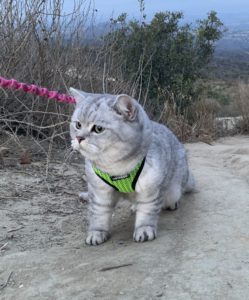

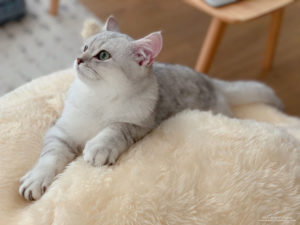
Standard/Traditional: Born with a darker color on them, but they will lighten up over time. They usually look like a little tabby or marble color at birth, then lighten up as they get older. They will typically have green eyes.


Color Point: Born totally white, but within a few weeks will begin to show color shading … this shading will change due to temperature. Darker when cold. Lighter when Warm. They can have an overall shading, but most will always be darker at their points. They always have blue eyes. For more in-depth information about color points, click here.
The color of their paw pads determines the color of the shading. If the pads are black, then it would be a Black Silver Shaded or a Black Silver Chinchilla. If it’s a point, then it would be called a Black Silver Shaded Point or a Black Silver Chinchilla Point. These shadings can range from various colors, including black, Blue, Cream, Lilac, Chocolate, golden, and more.
Then come other patterns …


Lynx … A lynx would have dark stripes on its legs, face, and sometimes tail, looking like a lynx. So, that would be called a Black Silver Lynx or Black Silver Lynx Point if the Pads are Black. Again, color could be Black, Blue, and so on.


Torbie .. They have a marble-like pattern on them. Usually, it is always female. This Photo is of a male. It’s rare to see a male Torbie.


Ticked or Tabby … They are striped all over, compared to the Lynx


Chinchilla … They have minimal shading on the very tips of the hair shaft. Normally 1/8th are less is shaded on the tips. So they look mostly white.


Silver Shaded .. They have much more shading than the Chinchilla. Approximately 1/4th or more of the tips of the hair shafts are shaded. As a result, the shading is much more noticeable.
All the photos of the different patterns are variations of the silver gene BSHs, resulting in a wide range of both color and pattern. There are actually other patterns, but these are the ones that I breed.
The other issue I have run across is that there are many names for the same colored cat across the breeds in the silvers … so even within the British Shorthair, you will see a Chinchilla called a Silver Tipped, Shell, and so on. This is usually due to it being from another breed, and the name just stuck. This is why Doug and I have decided to join forces to try to gain a better understanding of the confusion, even within the cat world, and the judging of the Silvers, so that it is more uniform and easier across the board.
History of Chinchillas and Silver Shaded British Shorthairs:
The origin is the British Isles, where thousands of years ago, their ancestors inhabited it. British Shorthair – is a harmonious, medium or large-sized animal with a muscular, solid, well-developed body; strong legs; powerful chest; round head with big cheeks; short and thick neck.
British Shorthair breeder Norman Winder derived British Shorthair Chinchillas in the early 1970s. He bred a cross between a Persian Chinchilla and a British Shorthair cat. His experiment was a complete success: in 1973, Winder demonstrated at the exhibition a new breed named the British Shorthair black-tipped or “British Shorthair black silver tipped (Silver Shaded)”. The Board of Cat Clubs in England recognized this color in 1980. Since this time, due to other excellent breeders, the Silver Shaded and Chinchilla British Shorthair have come a long way, and some exquisite color patterns and colors are now making their way to Cat Shows and Loving homes.
“Silver” is a pure white coat color. Silver Shaded and Chinchilla British Shorthair – is an almost white cat, with “sprayed” black color at the very tips of the hairs. Only one-third of the hair of Black Silver Shaded British Shorthair cats has a black “covering”; the hind legs extend to the hock, and the palms are black. British Shorthair Chinchilla (Black Silver Shell) Cats’ color has even less colored coverage, about 1/8 of the hair, and their hind legs are white; only the palm pads are black (or other colors). Silver Shaded coats should have shades of black (or another color, such as blue, Chocolate, etc.) on the back, sides, head, ears, and tail. Uniformity of a color is more important than its contrast. The chin, stomach, and underside of the tail should be white. (Note: The Silver shaded and Chinchilla British Shorthairs now come in many colors. They will always be primarily white, but the coverings, paw pads, points, and tips can be blue, golden, Chocolate, and many more colors, thanks to breeders developing this very unique colored British Shorthair.) They also come in Color Points as well as Traditional Colors, in the other colors mentioned. The Color Points will normally always have blue eyes, whereas the Traditional will have Green Eyes.)
The name “chinchilla” originated from the color of its fur, which resembles that of these amusing animals. Since the modern British Shorthair Silver Shaded and Chinchilla has Persian and Exotic ancestry, this breed is both long-haired and shorthaired.
These regal cats are of extraordinary beauty! Their white mantles, with slightly blackened tips of the hair, give them a great, elegant look. They are generously endowed with natural makeup: eyes, lips, and nose of chinchillas encircled by black lines. Large expressive emerald-green eyes, a lovely red nose, lips curved in a mysterious smile (This is the breed the Cheshire Cat came from in Alice in Wonderland), and black palm pads are a nice contrast to the shining snow-white fur. British Shorthairs and Chinchillas mature very slowly, taking up to 4 years to grow and reaching full growth at around 5 years old. They look great all their life, up to 18-20 years. Female cats are much smaller in comparison to males; they have a shorter jaw and reach maturity at 2-3 years.
British Shorthair Silver Shaded/Chinchilla Temperament:
Currently, due to the exquisite form inherited from the Persians, the British Shorthair’s calm and balanced nature, as well as its Silver Shaded, Lynx, and Chinchilla varieties, is in high demand. They are worthy favorites of the breed and the pride of their owners. Good manners of British Shorthair in their blood. They feel perfectly at home in a city apartment or country house; they easily get along with other cats and dogs. You can feel their wise, innate intelligence, dedication, and kindness. And due to the Persian in them, these Silver beauties tend to be much more affectionate than their counterparts and love to be held and cuddled. British Shorthair cats are known for their calm demeanor and playful nature. They do not lose their temper easily. These cats will please and surprise you. They will not sit long in your lap, but more likely will lie by you and enjoy your closeness. They are incredibly loyal and affectionate. Many say the Silver Shaded/Chinchilla British Shorthair is more dog-like, being a Faithful, loyal, and Loving companion, yet still retains the independence of a cat. It is also easy to train to perform different tricks. I have found this to be very accurate with my little ones. They sleep with me and love to cuddle, play, and stay close to me most of the time. But still love to explore and play on their own as well.